Request Quote

Moving into a new construction home means your address may not exist in the USPS database yet. Until it does, mail won't arrive, packages get returned, and banks or government agencies may reject your address during account updates.
Budget Mailboxes works with homeowners, builders, and HOA managers on new construction mail delivery every day, and the single most common source of frustration is not knowing how to register a new address with USPS or who is even responsible for it.
This guide covers every step: from getting your address officially assigned to installing a compliant mailbox and verifying USPS has it on record. Developers and HOA managers coordinating multi-unit mail delivery will find the CBU and cluster mailbox guidance in Step 5 directly applicable.
Who Creates Your New Address? (Local Government vs. USPS)
Most homeowners assume USPS assigns their address. USPS does not. Local government creates it.
Your city, county, or municipal addressing authority assigns every new street address during the permitting or occupancy process. The relevant office goes by different names depending on your jurisdiction: planning department, building department, zoning office, or 911 addressing office. Once your local government officially assigns a USPS new construction address, USPS receives that information and adds it to the Address Management System (AMS), the national database USPS uses to route and deliver mail.
Until your address clears both steps, USPS cannot deliver to it. No amount of submitting a change-of-address form will register a new address that the local government has not yet assigned.
Builders who pull permits early in construction may receive an assigned address well before occupancy. Buyers who purchase a finished home in an established subdivision inherit an address already in the system. If yours is not recognized yet, the local addressing office is the first call to make, not the post office. Browse mailboxes for new construction once your address is confirmed and you're ready to select a compliant unit or visit USPS FAQ for more details
How to Register Your USPS New Address: Step-by-Step
Registering a new construction address with USPS requires coordinating between your local government and the post office. Follow these five steps in order.
-
Contact your local government addressing office
-
Gather required documents
-
Visit your local post office
-
Submit a change-of-address form
-
Install a USPS-approved mailbox
Step 1: Contact Your Local Government Addressing Office
Call your city or county building, planning, or zoning department and ask about new address assignment for your property. Confirm what construction milestone triggers assignment (foundation, framing, or certificate of occupancy) and request written confirmation of your official address once issued. Processing times vary by jurisdiction.
Step 2: Gather Required Documents
Bring the following to your post office visit. USPS requires documentation to verify ownership and occupancy for new address registration.
Required documents include:
-
Land deed or title: Proof of legal ownership of the property
-
Certificate of occupancy: Issued by your local building department; confirms the structure is legally habitable
-
GPS coordinates or survey data: Especially important for rural or undeveloped parcels
-
Primary photo ID: USPS accepts a valid driver's license, state-issued ID, U.S. passport, military ID, or permanent resident card
Step 3: Visit Your Local Post Office
To register a new address with USPS, ask to speak directly with the Postmaster. Present your documents and explain you are registering a new construction address.. The Postmaster confirms the address against local government records, assigns it to a carrier route, and initiates delivery activation. Request written confirmation that the address is active.
Step 4: Submit a Change-of-Address Form
If you are also moving from a previous address, submit PS Form 3575 to forward your mail. You can do this online at moversguide.usps.com ($1.10 identity verification fee) or in person at the post office at no cost. USPS forwards First-Class Mail and Priority Mail for up to 12 months. Marketing Mail does not forward.
Note: a COA form forwards existing mail to your new address. It does not create the new address in the USPS system. Both steps are necessary if you are relocating from a prior address.
Step 5: Install a USPS-Approved Mailbox
USPS will not deliver to a property without an installed, compliant mailbox. Residential curbside mailboxes must meet these standards:
-
Height: Mailbox opening sits 41–45 inches above the road surface
-
Distance from curb: 6–8 inches from the road edge
-
Address labeling: Unit numbers displayed on both the mailbox and the post in letters at least 1 inch tall
-
No obstructions: Clear carrier access from the road; no advertising or signage on the mailbox
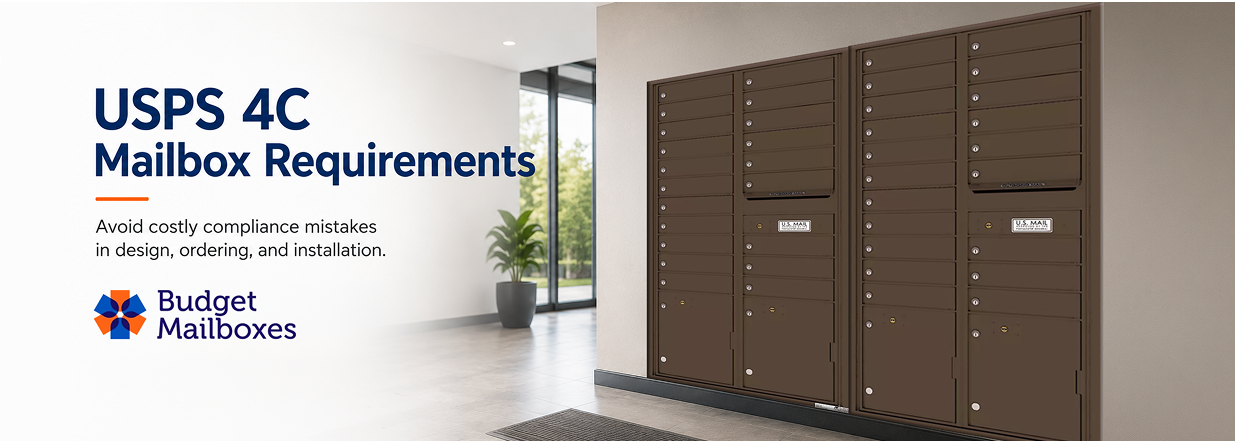
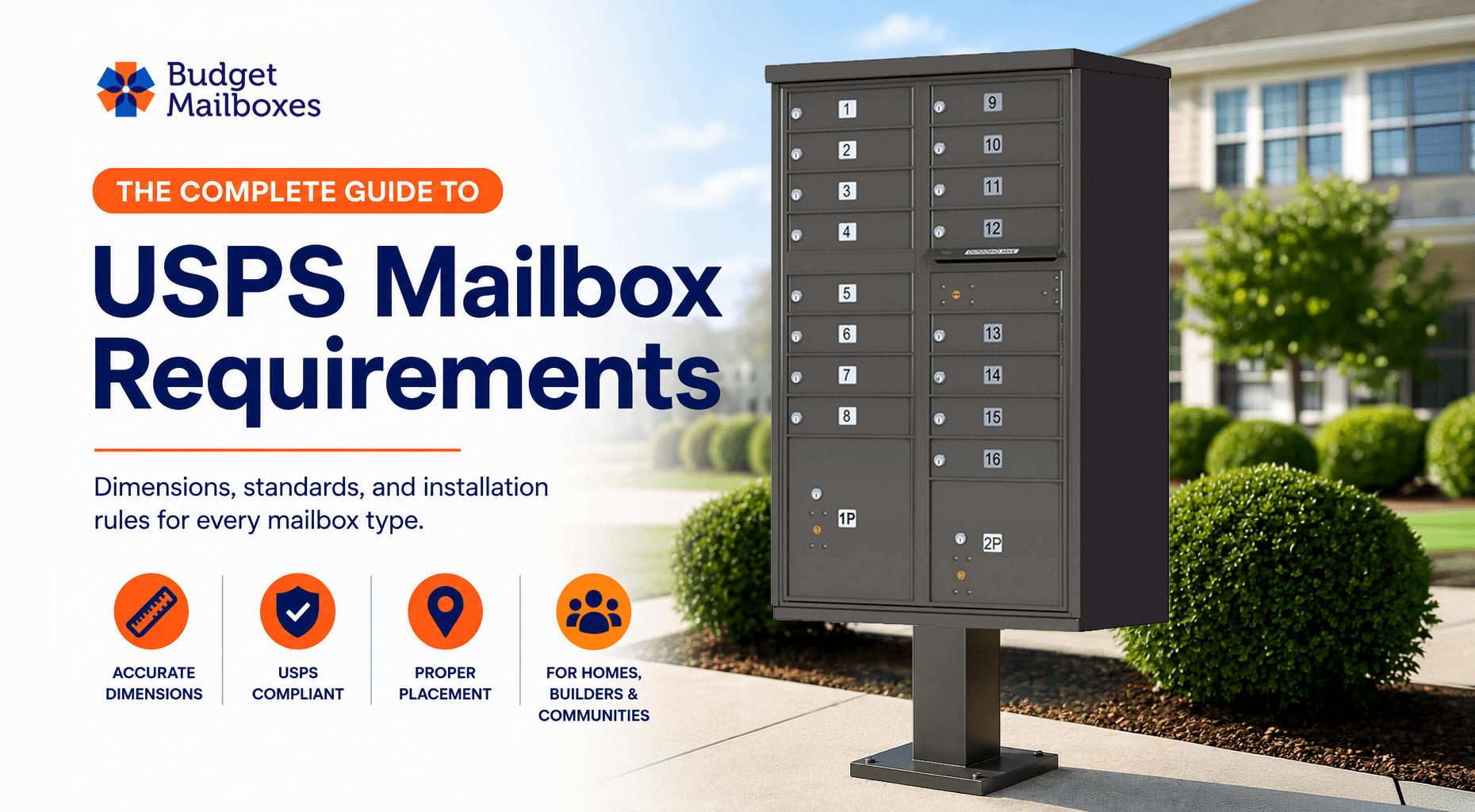
Multi-unit properties and new subdivisions require a Cluster Box Unit (CBU) manufactured to USPS STD-4C standards. USPS installs the arrow lock and approves final placement after installation. Browse cluster mailboxes and USPS-approved mailboxes to find compliant options for your property type. For installation guidance and compliance details, see our cluster mailbox installation guide, USPS cluster mailbox regulations, and the USPS compliance builder's guide.
Change of Address for Special Situations
Certain circumstances require a different COA process. Here's what applies to each.
Temporary Change of Address (15 Days–1 Year)
A temporary COA is appropriate for seasonal residences, extended travel, or construction delays that push your move-in date. Submit online at moversguide.usps.com ($1.10) or in person for free. Temporary forwarding applies to First-Class Mail and Priority Mail only. Marketing Mail does not follow. For absences under 30 days, USPS Hold Mail is a simpler alternative: USPS holds your mail at the local post office for up to 30 days at no charge.
Change of Address for a Deceased Person
A USPS change of address for deceased family members cannot be submitted online. A family member or authorized representative must visit the post office in person with executor or administrator paperwork. A death certificate alone is not sufficient. Power of attorney is invalid after death. Complete PS Form 3575 at the counter. To stop unsolicited marketing mail, register at DMAchoice.org. Visit USPS Mail For Deceased for more info
Business Change of Address
Businesses submit a COA online or in person. In-person submissions require a notarized letter, a signed letter on company letterhead, or a power of attorney document. USPS forwards business mail for up to 12 months. Update licenses, vendor accounts, and financial institutions separately: USPS forwarding does not notify senders.
Military Moves and International Relocations
Service members relocating via PCS should coordinate through their unit command first. USPS receives address data through the Address Military Post System (AMPS). Online COA submissions require a .gov, .mil, or .edu email address. International relocations must be submitted in person before departure.
|
Situation |
Method |
Key Documents |
Online Option |
|
Temporary |
Online or in-person |
Photo ID |
Yes ($1.10) |
|
Deceased |
In-person only |
Executor/admin paperwork + ID |
No |
|
Business |
Online or in-person |
Notarized letter or signed letterhead |
Yes ($1.10) |
|
Military |
In-person preferred |
.mil/.gov email for online |
Limited |
What If Your New Construction Address Is Not Recognized by USPS?
If USPS or a private carrier rejects your new construction address not recognized by their system during checkout or delivery, the address has not yet been standardized in the AMS database. This is common in new subdivisions where addresses are assigned in batches and AMS updates lag behind local records. Knowing how to add a new construction address to USPS starts with identifying where the gap occurred.
Start with these troubleshooting steps:
-
Verify with local government first: Confirm your address was officially assigned and ask when it was submitted to USPS. Some counties submit address assignments weekly; others do so monthly.
-
Check with your builder: Builders and developers coordinate address assignment during permitting. Your builder may have documentation confirming when the address was submitted to the local addressing office and whether that submission reached USPS.
-
Contact your local Postmaster in person: Online tools can reflect AMS data that is weeks behind the Postmaster's own records. A direct conversation confirms whether the address is on an active carrier route.
-
Contact the USPS AMS office: Call (800) 238-3150 or use the AMS office locator at postalpro.usps.com. The AMS office manages address standardization and can escalate unresolved cases directly.
-
Cross-reference with your tax assessor's records: An address on county tax records that is absent from USPS AMS signals a submission gap between local government and postal records. Your county assessor can confirm whether the address was submitted and when.
If mail delivery is urgent while the address activates, two temporary solutions keep mail accessible:
-
Request a PO Box: A PO Box at your local post office provides a deliverable address immediately while the permanent address processes through AMS.
-
Request USPS Hold Mail: USPS holds mail at your local post office for up to 30 days at no charge. This works for short-term gaps while the address clears the system.
AMS updates can take up to six months without proactive follow-up. Calling the Postmaster directly is the fastest resolution path.
How Long Does It Take for USPS to Recognize a New Address?
Homeowners asking how long it takes for a new address to be recognized should expect different timelines depending on the situation. Standard change-of-address requests process in 7–10 business days. New construction addresses take longer: 2–4 weeks is common, and timelines stretch further when local government submissions to USPS AMS are delayed.
Factors that affect the timeline include:
-
Local government processing speed: Some counties submit address assignments to USPS weekly; others do so monthly.
-
AMS batch update schedule: USPS updates the national ZIP+4 file on a rolling basis; new additions don't appear instantly.
-
Carrier route assignment: A new address in a new subdivision may require a carrier route update, which adds processing time.
To check whether USPS has recognized your address, use the free ZIP Code Lookup tool at tools.usps.com/zip-code-lookup.htm. Enter your street address, city, and state. A standardized result with a ZIP+4 code confirms the address is active in the USPS system. No result means the address has not yet been added. For new construction, calling your local Postmaster directly is more reliable than the online tool, as local records update faster than the national database.
How to Verify Your Address Has Been Successfully Reported to USPS
USPS address verification is a step most new construction buyers skip, and it causes downstream problems when banks, retailers, and government agencies reject the address. Use these methods to verify your address with USPS, ranked from easiest to most thorough. To check if an address is registered with USPS, work through this sequence:
-
Use the USPS ZIP Code Lookup Tool
-
Contact your local Post Office or Postmaster
-
Use the USPS AMS Office Locator
-
Take action if verification fails
Use the USPS ZIP Code Lookup Tool (Free, Instant)
The USPS address lookup tool at tools.usps.com/zip-code-lookup.htm is the fastest starting point. Enter your street address, city, and state. A standardized result with a ZIP+4 code confirms the address is in the USPS database. An "address not found" result means it has not yet been added or standardized. This tool is free, requires no account, and returns results instantly.
Contact Your Local Post Office or Postmaster
Call or visit and ask the Postmaster to confirm your address is active on a delivery route. This is the most reliable method to verify an address with USPS for new construction: the ZIP Code Lookup tool can lag several weeks behind the Postmaster's local records. A direct conversation with the Postmaster closes that gap and gives you a definitive answer.
Use the USPS Address Management System (AMS) Office Locator
Developers and multi-unit project managers should use the USPS address verification resource at postalpro.usps.com to locate their regional AMS office. The AMS office confirms whether addresses are standardized and included in the national ZIP+4 file. Call (800) 238-3150 for direct AMS assistance. This method is the most thorough option available and is the appropriate escalation path for subdivision-scale projects.
What to Do If Verification Fails
If the ZIP Code Lookup does not return your address, work through this sequence: contact the Postmaster in person, call the AMS office at (800) 238-3150, and verify the address assignment with your local government. Also confirm whether your area is designated as a PO Box-only delivery zone: some rural and newly developed areas receive mail exclusively through PO Boxes until carrier routes are established, and a standard street address will never activate for home delivery in those zones. USPS updates can take up to six months without proactive escalation. See the troubleshooting section above for the full step sequence.
Understanding USPS Address Standardization
What Is USPS Address Standardization?
USPS address standardization converts every mailing address into a uniform format the Address Management System (AMS) can recognize and process. Standardization applies standard abbreviations (Street becomes ST, Avenue becomes AVE), corrects minor spelling errors, and appends the ZIP+4 extension to improve sorting precision. A raw address submitted by a builder might read "123 Maple Street" while the standardized AMS version reads "123 MAPLE ST 78701-4521." Standardization reduces UAA (undeliverable as addressed) errors across the entire mail stream and is the foundation of reliable mail delivery at scale.
What Is CASS Certification?
CASS stands for Coding Accuracy Support System. CASS-certified software matches any deliverable address against the USPS national ZIP+4 file to confirm it is standardized and deliverable. E-commerce checkout validators, bank address fields, and online address verification tools all run on CASS-certified systems. Service bureaus, commercial mailers, and software developers also use CASS to validate address lists before mailing campaigns or database updates. If your new construction address passes a CASS-certified check, it is standardized in the USPS database and ready for delivery.
Why Standardization Matters for Your New Construction
Until your address is standardized in AMS, online retailers, financial institutions, and government agencies will reject it during checkout or account updates because their systems pull from the same USPS database. You may be unable to update your driver's license, voter registration, insurance records, or financial accounts. The frustration extends well beyond missed mail. Proactive registration with the Postmaster and follow-up verification are the fastest path to standardization. Use the methods covered in the How to Verify Your Address Has Been Successfully Reported to USPS section above to confirm your address has cleared the system.
USPS Mailbox Requirements for New Construction
Buyers and developers must install a compliant mailbox before USPS initiates delivery. USPS does not deliver to a property without one. Residential curbside mailboxes must meet these usps mailbox requirements:
-
Height: Mailbox opening sits 41–45 inches above the road surface
-
Distance from curb: 6–8 inches from the road edge
-
Slot size: The mail slot opening must be at least 1.75 inches high by 7 inches wide to accommodate standard letter mail
-
Address labeling: Unit numbers displayed on both the mailbox and the post in numerals at least 1 inch tall; street name displayed on the mailbox where required by the local postmaster
-
No advertising: No commercial advertising, signage, or non-address markings permitted on any USPS-approved mailbox
|
Mailbox Type |
When Required |
Key Requirement |
|
Residential curbside |
Single-family homes |
41–45" height; 6–8" from curb; slot min. 1.75" × 7" |
|
Cluster Box Unit (CBU) |
New subdivisions and multi-unit |
USPS STD-4C; arrow lock installed by USPS |
|
4C Horizontal |
New multi-unit residential construction |
Required under USPS STD-4C for new builds |
CBUs and 4C horizontal mailboxes are the cluster mailbox standard for new construction under USPS STD-4C. Postal officials complete the arrow lock installation and approve final placement after the unit is in place. Builders and property managers cannot self-install the arrow lock. Attempting to do so will result in USPS withholding delivery until the issue is corrected. Budget Mailboxes offers USPS-approved mailboxes including CBUs and 4C horizontal units built to STD-4C for new construction projects of any scale.
For detailed installation and compliance guidance, see the cluster mailbox installation guide, USPS cluster mailbox regulations, and the USPS compliance builder's guide.
Updating Your Address with UPS, FedEx, and Other Carriers
Private carriers maintain separate address databases and do not use USPS AMS. A new address USPS hasn't recognized yet may still accept UPS or FedEx deliveries if GPS routing confirms the physical location. Builders and new homeowners moving into recently completed properties should update all carrier accounts before the first delivery is expected, not after a missed package.
Register your new address with each carrier directly:
-
UPS: Update through UPS My Choice at ups.com. UPS My Choice also allows delivery instructions and rerouting for packages already in transit.
-
FedEx: Update through FedEx Delivery Manager at fedex.com. FedEx Delivery Manager lets you set delivery preferences and authorize release at the new address.
-
Amazon: Update your default shipping address in your Amazon account before placing orders. Amazon uses its own logistics network for many deliveries and does not rely on USPS for address validation at checkout.
Updating all three accounts early prevents missed deliveries during the USPS activation window. Private carriers will deliver to a GPS-confirmed location even when the address is not yet active in the USPS system, but only if the address is registered correctly in each carrier's own database.
Conclusion
Registering a new construction address with USPS requires coordination between your local government and your local post office. Start with the addressing office, gather your documents, visit the Postmaster, install a compliant mailbox, and verify the address using the ZIP Code Lookup tool.
Builders coordinating mail delivery for multi-unit properties should plan for CBU installation and USPS arrow lock approval before occupancy. Budget Mailboxes has helped homeowners, builders, and HOA managers source compliant mailbox solutions for new construction projects across the country. Browse cluster mailboxes for multi-unit installations or request a bulk quote for your development project.
Frequently Asked Questions
Contact your local government addressing office to get the address officially assigned. Then visit your local post office with your land deed, certificate of occupancy, and photo ID. The Postmaster adds the address to the carrier route and initiates USPS recognition.
Use the USPS ZIP Code Lookup tool at tools.usps.com. If your address returns a standardized result with a ZIP+4 code, it is in the USPS database. You can also call your local post office and ask the Postmaster directly.
No. New construction address registration must be done in person at the post office. The change-of-address form for mail forwarding is available online, but it does not create a new address in the USPS system.
Bring your land deed or title, certificate of occupancy, GPS coordinates if available, and a government-issued photo ID. USPS accepts a driver's license, state ID, U.S. passport, military ID, or permanent resident card.
Use the free ZIP Code Lookup tool at tools.usps.com/zip-code-lookup.htm. Enter your street address, city, and state. A result with a ZIP+4 code confirms the address is standardized and active. If the tool returns no result, contact your local Postmaster in person: local records update faster than the national database.