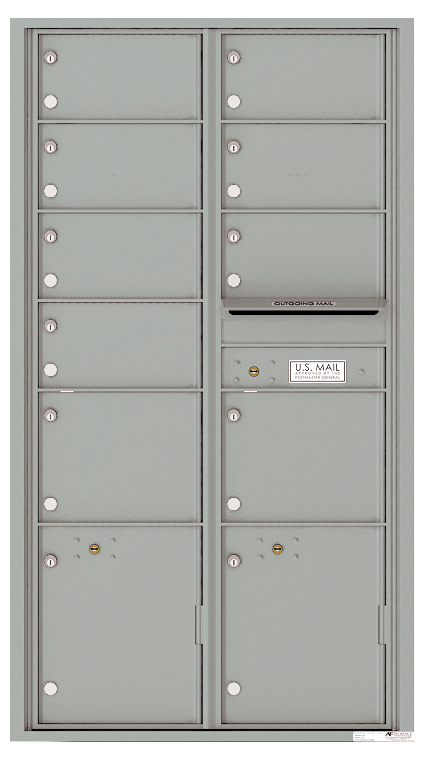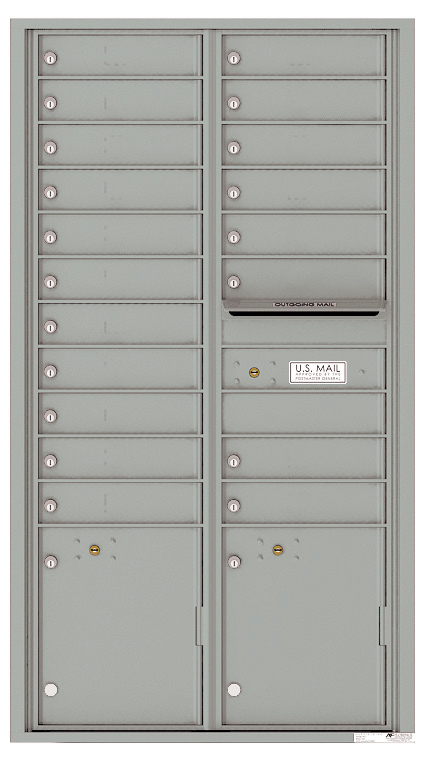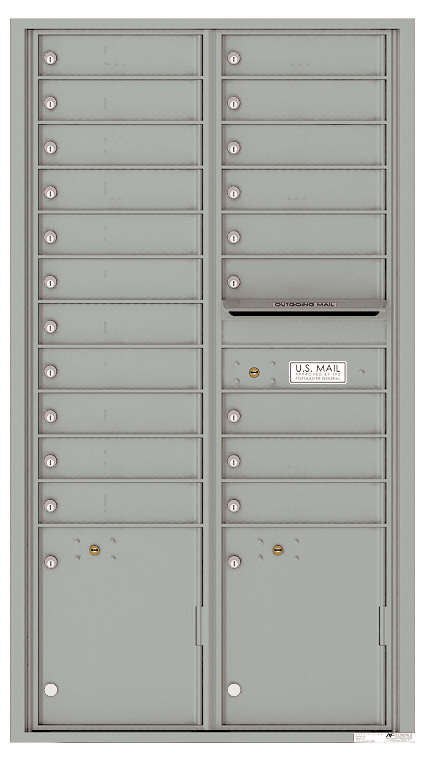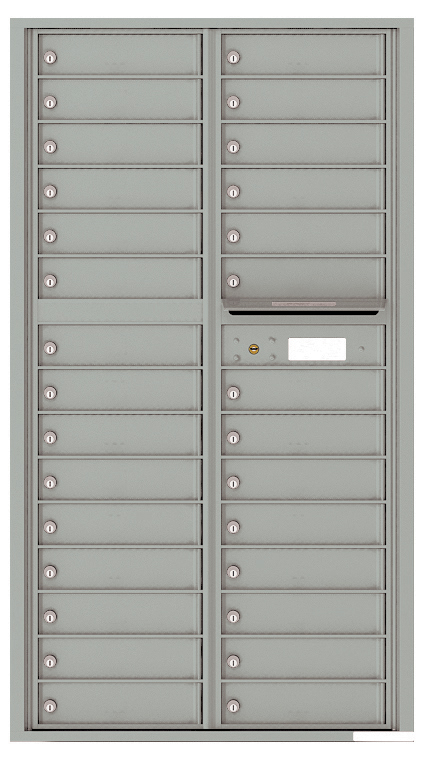
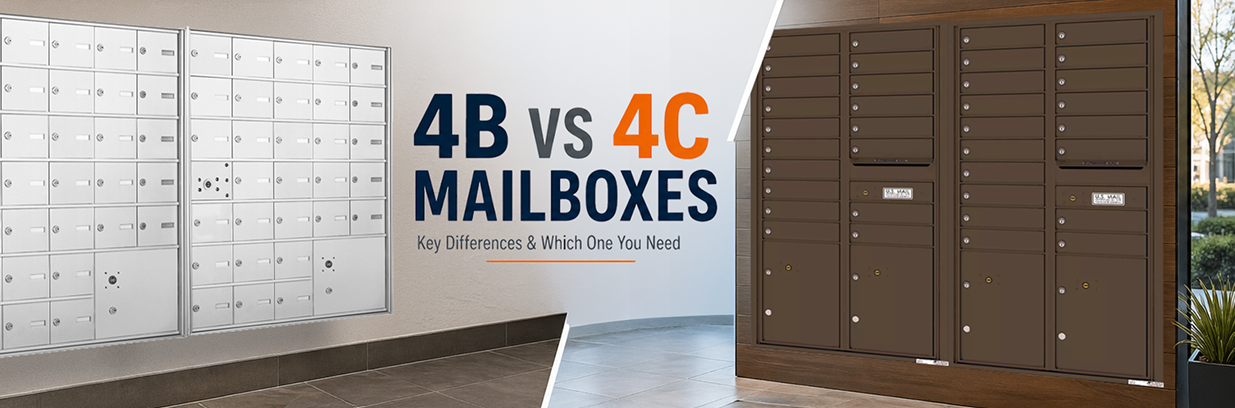
The first question most property managers, developers, and architects face when specifying a centralized horizontal mailbox system is this: does the project require 4B or 4C mailboxes? Both are USPS standards for centralized mail delivery in multi-unit buildings, but regulations determine which one applies to your project. Getting it wrong can hold up your USPS approval, delay your build, or result in a failed inspection. This article breaks down the key differences between 4B vs 4C mailboxes and helps you make the right choice.
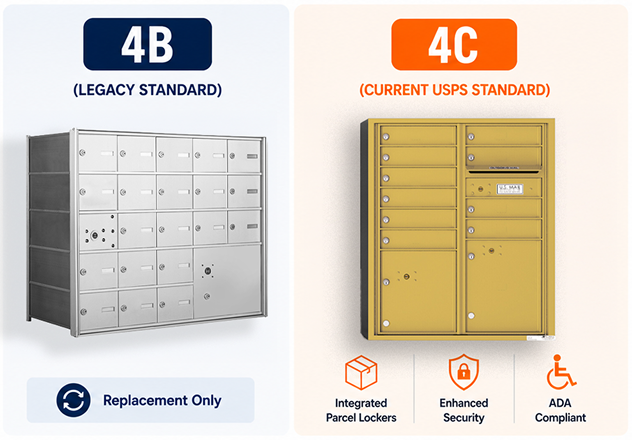
4C mailboxes are the current USPS standard required for all new construction since October 6, 2006. They feature horizontal compartments, integrated parcel lockers, ADA-compliant design, and enhanced security hardware. 4B mailboxes are the legacy standard, approved today only for direct, like-for-like replacements in buildings with pre-2006 permits.
What Are STD-4B Mailboxes?
The STD-4B standard was introduced by USPS in the 1970s as the specification for centralized horizontal mailbox systems in multi-unit residential and commercial buildings. For decades, 4B units were the standard choice for apartment complexes, office buildings, and condominium developments across the country.
4B mailboxes are designed for recessed wall-mount installation and are approved for indoor use only. Compartments may be horizontal or vertical depending on the configuration, and units were typically constructed with lighter-gauge materials than what the newer 4C standard requires. Security relied on basic cam locks rather than the five-pin cylinder and arrow lock system that 4C introduced.
4B was the default standard for multi-unit buildings until October 6, 2006, when USPS mandated STD-4C for all new construction. Today, 4B mailboxes are approved in one scenario only: direct replacement of an existing installation with no changes to the wall opening, compartment count, or configuration. Browse 4B horizontal mailboxes to see available replacement units, including vertical mailboxes that fall under the same STD-4B classification and replacement rules.
What Are STD-4C Mailboxes?
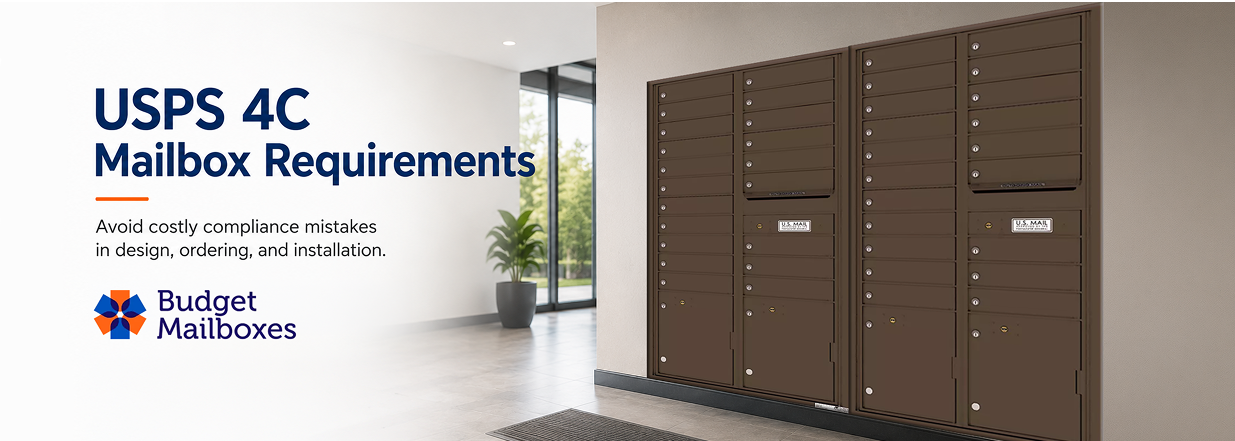
STD-4C is the current USPS standard for centralized mail delivery in multi-unit buildings, and all new 4C mailboxes installed today must meet its specifications. USPS released the STD-4C specification in 2004 and made it mandatory for all new construction with building permit applications dated on or after October 6, 2006. If your project is new construction or a major renovation, a 4C mailbox is the only USPS-compliant option.
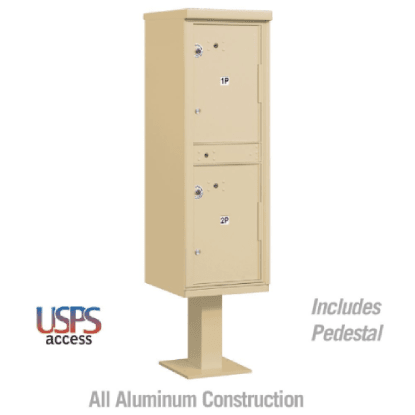
Understanding USPS 4C mailbox requirements starts with what the standard actually mandates. Compartments are standardized at 12 inches wide by 15 inches deep by 3 inches high, horizontal-only orientation. Every unit requires integrated parcel lockers, anti-pry doors, internal hinges, and a USPS arrow lock combined with five-pin cylinder tenant locks. ADA accessibility requirements are built into the design specification, covering reach-range height and clearance standards.
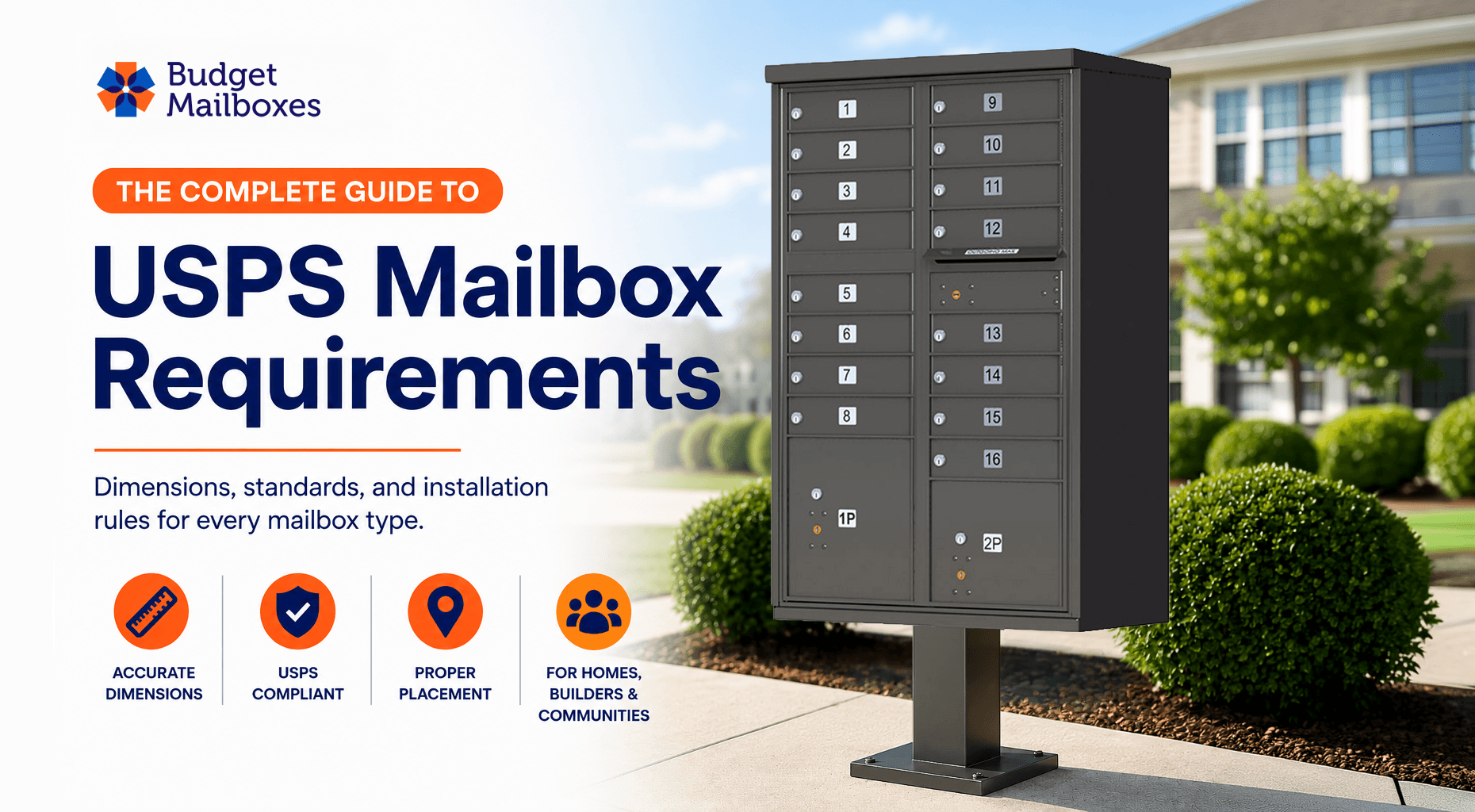
4C mailboxes also support multiple installation configurations: recessed wall mount, surface mount, and freestanding depot or kiosk style. This makes them adaptable to a wider range of building types and layouts than 4B.
The result is a system that's more secure, more accessible, and better suited to modern package volume than anything the 4B standard offered. Browse 4C horizontal mailboxes to see the full range of configurations available. For context on the broader category these units belong to, see our guide to cluster mailboxes.
Key Differences Between 4B and 4C Mailboxes
Understanding the key differences in comparing 4B and 4C mailboxes goes beyond the year each standard was introduced. The two systems differ in construction, security architecture, accessibility compliance, and parcel handling requirements. The comparison table below captures the key attributes side by side; the H3 sections that follow break each dimension down in detail.
Side-by-Side Comparison Table
The following 4b vs 4c mailboxes comparison covers every major attribute across both standards, from compartment dimensions and security hardware to installation types and approved use cases.
|
Feature |
STD-4B |
STD-4C |
|
USPS Standard |
STD-4B |
STD-4C |
|
Year Introduced |
1970s |
2004 (mandated 2006) |
|
Compartment Orientation |
Horizontal or vertical |
Horizontal only |
|
Compartment Size |
Variable |
12"W x 15"D x 3"H (standard) |
|
Parcel Locker Requirement |
Not standardized |
1 per 5 tenant compartments |
|
Security Features |
Basic cam locks |
Anti-pry doors, internal hinges, arrow lock, 5-pin cylinder |
|
ADA Compliance |
Not required by spec |
Required |
|
Primary Materials |
Lighter-gauge aluminum |
Heavy-gauge aluminum, stainless steel hardware |
|
Installation Types |
Recessed wall mount (primarily) |
Recessed, surface mount, freestanding |
|
Approved Use Cases |
Like-for-like replacement only |
New construction, major renovation, replacement |
|
Indoor/Outdoor Suitability |
Indoor only |
Indoor or covered outdoor |
Design and Construction
The most visible difference between 4B and 4C units is construction quality. A 4C horizontal mailbox uses heavier-gauge aluminum throughout, with stainless steel hardware and a modular design that allows flexible configuration to match the exact compartment count a building requires.
Compartments in 4C units are standardized at 12 inches wide, 15 inches deep, and 3 inches high, horizontal mailbox orientation only. 4B compartments were not held to a uniform size specification, which is why older installations vary considerably in both dimension and orientation. Some 4B configurations include vertical compartments; 4C does not.
The modular nature of 4C is particularly useful for developers. Units can be assembled to provide the exact number of tenant compartments needed, with parcel lockers integrated into the same structure rather than added as separate fixtures.
Security Features
The USPS 4C mailbox requirements for security represent a significant step up from what the 4B standard ever mandated. 4C mailboxes were designed with mail theft in mind: anti-pry doors and internal hinges prevent the prying attacks that older 4B units were vulnerable to. Tenant compartments use five-pin cylinder locks, and every 4C unit requires a USPS arrow lock, which allows carriers to open all compartments simultaneously for delivery.
Given current 4C mailbox requirements for security, 4B's basic cam locks are no longer acceptable for new installations. Cam locks offer far less resistance to tampering, and this gap was one of the primary reasons USPS updated the standard in 2004. For buildings in areas with elevated mail theft concerns, the security architecture of 4C is a meaningful upgrade regardless of regulatory requirements.
ADA Compliance and Accessibility
4B mailboxes were specified before ADA accessibility standards were applied to commercial mailbox installations. The 4C standard builds ADA compliance directly into the specification, covering reach-range height requirements and clearance standards that allow all tenants, including those using wheelchairs, to access their compartments independently.
ADA reach-range requirements specify that mailbox compartments must be installed with the highest operable part no more than 48 inches from the floor for a forward reach, or 54 inches for a side reach. 4C units are designed to accommodate these height parameters. See the ADA Standards for Accessible Design for the full reach-range specifications. 4B installations have no equivalent built-in height specification, making compliance dependent on how the unit was originally installed rather than the standard itself.
For property managers and developers, this matters beyond regulatory compliance. Buildings that fail to meet ADA standards on mailbox installations face potential accessibility lawsuits and, in some cases, certificate of occupancy issues. 4C's built-in compliance removes that risk for new projects.
Parcel Locker Requirements
The current USPS requirement for 4C installations is one parcel locker for every five tenant compartments. This ratio was updated before 2021 from the previous 1:10 standard, a direct response to the dramatic increase in residential package volume driven by e-commerce growth. For a 40-unit building, that means eight dedicated parcel lockers are required under the current specification.
This is a critical consideration for any building handling regular e-commerce package volume. Without adequate parcel lockers, carriers leave packages at doors or hold them at the post office for tenant pickup, both of which generate complaints and create theft exposure. The 4C parcel locker requirement exists precisely to solve this problem at the building level.
4B units may include parcel lockers, but there is no standardized ratio requirement in the 4B specification. For property managers evaluating a replacement or upgrade, the gap between an unstandardized 4B parcel setup and a compliant 4C configuration is often reason enough to move to 4C even where USPS doesn't strictly require it.
Mailboxes in Existing Buildings: What Standard Applies?
Yes, 4B mailboxes are still legal, and yes, you can replace a 4B mailbox with another 4B, but only under specific conditions. Existing buildings may continue using STD-4B units under the USPS like-for-like replacement rule, provided the replacement matches the exact existing configuration with no changes to the wall opening. Outside those conditions, USPS requires an upgrade to 4C.
Contact your local postmaster and obtain written approval before ordering any 4B replacement units. If the replacement doesn't match the original specs, USPS will withhold arrow lock service and tenants cannot receive mail until a compliant system is in place.
Vertical mailboxes fall under the same STD-4B classification and follow the same replacement rules. Browse 4B horizontal mailboxes only after confirming your replacement qualifies.
When 4B Replacement Is Allowed
USPS permits a direct 4B replacement when all of the following conditions are met:
-
The building's original permit predates October 6, 2006
-
The replacement is a direct 1-to-1 swap of the existing unit
-
No changes are made to the rough opening dimensions
-
The compartment count and configuration remain identical
-
Written approval from your local USPS postmaster is obtained before ordering
A cosmetic update such as replacing worn doors, rekeying locks, or repainting a unit does not trigger the 4C requirement. What triggers it is any physical change to the rough opening or the number of compartments served.
When an Upgrade to 4C Is Required in Existing Buildings
An existing building must transition to 4C mailboxes if the scope of the work goes beyond a direct swap. Scenarios that require an upgrade include:
-
Adding tenant units or expanding the number of compartments
-
Modifying the mailroom wall or changing the rough opening dimensions
-
Switching from recessed to surface mount (or vice versa)
-
Any renovation that USPS classifies as "major"
This is not discretionary. If the installation doesn't meet 4C standards and USPS determines it's outside the like-for-like exception, they'll decline to install the arrow lock. Tenants in the building won't have mail delivery until a compliant system is in place. The cost of retrofitting after the fact is considerably higher than planning for 4C from the start. Browse 4B horizontal mailboxes if you've confirmed your replacement qualifies.
Mailboxes in New Construction: 4C Is the Only Option
For any project with a building permit application dated on or after October 6, 2006, USPS STD-4C compliant mailbox systems are the only approved option. No exceptions apply for new construction. This covers residential developments, apartment complexes, condominiums, office buildings, mixed-use developments, and any other project creating new USPS delivery points.
Meeting USPS 4C mailbox requirements is not optional and cannot be deferred. USPS will not provide arrow locks for non-compliant installations, meaning tenants in a new building cannot receive USPS mail until the correct system is in place. It is not a problem that gets corrected with a form or a phone call. The 4C mailboxes need to be in place before USPS activates delivery, and post-construction retrofits are significantly more expensive than specifying the right system from the start.
The practical implication for developers and architects: 4C mailbox planning needs to happen during the building design phase, not after framing. Rough opening dimensions for recessed installations, ADA-compliant placement height, and parcel locker ratios all need to be factored into the wall and mailroom design before construction begins. Budget Mailboxes offers bulk pricing and configuration assistance for new construction projects. Browse 4C horizontal mailboxes to start, or request a bulk quote for volume pricing on larger developments.
Planning 4C Mailboxes for Your Development
Use the following steps to specify your 4C mailbox configuration during the design phase:
-
Determine the number of tenant compartments needed. One compartment per delivery point, plus any shared-use compartments required by your building type.
-
Calculate parcel locker requirements. The current USPS standard requires one parcel locker for every five tenant compartments. A 50-unit building requires a minimum of ten parcel lockers.
-
Choose your mounting type. Recessed 4C horizontal mailboxes are the most common choice for new construction. Surface mount and freestanding configurations are available where wall integration isn't possible.
-
Account for ADA reach-range in placement planning. The highest operable part of any compartment must not exceed 48 inches from the floor for a forward reach approach.
-
Verify your configuration with your local USPS postmaster before finalizing building plans. Written confirmation protects you from a compliance correction after construction.
-
Request a bulk quote for volume pricing. Budget Mailboxes offers bulk order pricing for new construction and large-scale developments, with configuration assistance included.
When to Use 4B vs 4C Mailboxes
The regulatory framework is clear. The right standard for your project depends on three factors: the project type, the permit date, and the scope of the work.
New construction with a permit dated on or after October 6, 2006 requires USPS STD-4C compliant mailbox systems. Major renovation that involves any changes to the existing mailbox wall opening, compartment count, or configuration also requires 4C mailboxes. The only scenario where 4B mailboxes remain a legal option is a direct, like-for-like replacement of an existing 4B installation where nothing structural changes.
If you're uncertain which scenario applies to your project, the answer is the same in all three cases: contact your local postmaster before ordering. USPS is the authority on what your installation requires. Getting written confirmation before you purchase protects you from an expensive correction after the fact. For a broader overview of the commercial mailbox landscape, the commercial mailbox buyer's guide and our coverage of USPS cluster mailbox regulations are useful starting points. Ready to order? Request a bulk quote for new construction projects or volume replacements.
Quick Decision Checklist
Use this checklist to identify which standard your project requires:
-
Is this new construction? If yes: 4C is required. No exceptions.
-
Is this a major renovation that changes the mailbox wall opening, compartment count, or configuration? If yes: 4C is required.
-
Is this a direct 1-to-1 replacement of an existing 4B unit with no structural changes? If yes: 4B may be allowed. Contact your local USPS postmaster for written approval before ordering.
-
Are you unsure which category applies? Contact your local postmaster. This step is non-negotiable before ordering any replacement or new unit.
Installation Options for 4B and 4C Mailboxes
A 4C horizontal mailbox supports three installation configurations: recessed wall mount, surface mount, and freestanding depot or kiosk. 4B mailboxes are primarily designed for recessed wall-mount installation and are approved for indoor use only.
Recessed wall mount is the most common horizontal mailbox configuration for both standards, integrating the unit flush into a dedicated wall opening in an indoor mailroom or lobby. Surface mount units attach directly to a wall without requiring a rough opening, making them a practical option for retrofit situations where cutting a new wall opening is not feasible. Freestanding configurations are available for 4C only, typically used in outdoor parcel locker kiosks and larger multi-building developments.
4C outdoor-rated configurations make it suitable for both indoor and covered outdoor installations. 4B units are not approved for outdoor use. Browse recessed 4C horizontal mailboxes to see the full range of recessed configurations available.
Shop Our 4B and 4C Horizontal Mailboxes
Budget Mailboxes carries USPS-approved 4B and 4C units from Florence Mailboxes and Salsbury Industries, the two primary manufacturers producing units to USPS STD-4B and STD-4C specifications. Both brands offer a full range of configurations, compartment counts, and mounting types, and every order ships free.
Whether you need a single Florence 4C mailbox for a like-for-like replacement or a full multi-unit configuration for a new development, bulk pricing is available on qualifying orders. If your project requires a custom configuration or volume pricing, request a bulk quote and our team will work with you on the right specification.
Budget Mailboxes has served thousands of property managers, developers, and facilities teams, including organizations like NBC, J.P. Morgan, and Harvard University. Browse 4C horizontal mailboxes or 4B horizontal mailboxes to find the right unit for your project.
Frequently Asked Questions About 4B and 4C Mailboxes
A 4C mailbox is the current USPS standard for centralized horizontal mail delivery in multi-tenant buildings, required for all new construction since October 6, 2006. 4C units feature standardized horizontal compartments, integrated parcel lockers, ADA-compliant design, and enhanced security hardware including anti-pry doors and USPS arrow locks.
Only if the replacement is a direct 1-to-1 swap with no changes to the rough opening dimensions or compartment configuration. Contact your local postmaster for written approval before ordering. If any structural changes are involved, USPS will require an upgrade to the 4C standard.
Only if the replacement is a direct 1-to-1 swap with no changes to the rough opening dimensions or compartment configuration. Contact your local postmaster for written approval before ordering. If any structural changes are involved, USPS will require an upgrade to the 4C standard.
The current USPS requirement is one parcel locker for every five tenant compartments. This was updated from the previous 1:10 ratio before 2021, reflecting increased package volume in residential buildings. 4B installations have no standardized parcel locker ratio.
Florence Mailboxes and Salsbury Industries are the two primary manufacturers producing USPS-approved 4B and 4C units. Budget Mailboxes carries units from both brands across the full range of configurations, compartment counts, and installation types, including 4C recessed mount options.