Request Quote
Every mailbox used for USPS delivery must meet federal standards. USPS mailbox regulations differ by mailbox type, property class, and delivery mode, and non-compliant installations can result in suspended delivery or costly rework. This guide covers USPS mailbox guidelines for every installation type: residential curbside, wall mount, door slots, locking, cluster/CBU, and 4C horizontal. Each section translates the USPS engineering standards (STD-7C and STD-4C) into plain-language specs with exact measurements pulled directly from the official USPS documents.
Homeowners replacing a curbside or wall mount unit will find the dimensional and post standards they need. Builders and developers will find a dedicated section on delivery mode determination and postmaster coordination, plus the documentation steps required before breaking ground. Property managers and HOA board members will find CBU, 4C, ADA, and parcel locker ratio requirements consolidated in one place, with the 2020 regulation updates flagged where they apply.
Budget Mailboxes has supplied USPS-approved mailboxes to homeowners, builders, and communities for years as an authorized dealer for Florence and Salsbury. Always confirm final placement with your local post office before installation.
Quick Reference: USPS Mailbox Specifications at a Glance
Use this table as a pre-order checklist. Height, setback, and the governing USPS standard vary by mailbox type, and ordering the wrong configuration can trigger a postmaster rejection or delivery setup delays. Curbside units follow USPS STD-7C, which sets the dimensional, materials, and breakaway-post specs for residential roadside delivery. Cluster and 4C horizontal units fall under USPS STD-4C, which governs centralized delivery for multi-unit residential and commercial buildings.
Wall mount, locking, and cluster installations also require additional postmaster approval beyond the basic dimensions, so reach out to your local post office during the planning stage rather than after the unit ships. The specs below cover the standard USPS mailbox height requirements and placement rules across all six installation types; verify final placement with your local post office before ordering.
|
Mailbox Type |
Height |
Setback / Placement |
Key Standard |
|
41–45″ from road surface |
6–8″ from curb face |
USPS STD-7C; PMG approval required |
|
|
41–45″ from ground |
Near main entrance |
Postmaster permission required to switch from curbside |
|
|
Bottom edge ≥30″ from floor |
Door or adjacent wall |
Min. opening 1.5″ × 7″ |
|
|
Matches base type |
Same as base type |
PMG seal mandatory; approved model required |
|
|
ADA-compliant reach range |
Postmaster-approved location |
USPS STD-4C; arrow lock installed by USPS |
|
|
Per STD-4C specs |
Indoor or outdoor kiosk |
Required for all new construction since Oct. 5, 2006 |
Curbside Mailbox Requirements
Curbside mailboxes are the most common USPS delivery setup, and USPS curbside mailbox requirements cover four areas: placement, post construction, address marking, and flag operation. Every unit must carry a valid Postmaster General (PMG) approval seal, which confirms the design has passed USPS engineering tests for durability, weatherproofing, and mail security. Browse compliant mailbox and post combos for ready-to-install kits that meet every spec below.
USPS curbside mailboxes must sit 41 to 45 inches above the road surface and 6 to 8 inches back from the curb face. The unit must carry a PMG approval seal, display address numbers at least 1 inch tall, and sit on the right-hand side of the road in the carrier's direction of travel.
|
Requirement |
Spec |
|
Height |
41–45″ above road surface |
|
Setback |
6–8″ back from curb face |
|
Road side |
Right-hand side in carrier's direction of travel |
|
Flag |
Must be visible from road; folds flat when no outgoing mail is present |
The 41 to 45 inch height range is set so carriers can reach mailboxes from inside their delivery vehicle without leaving the seat. These USPS mailbox height requirements apply across standard residential curbside delivery. Going higher or lower forces the carrier to stretch or stand, which slows the route and is grounds for the postmaster to refuse delivery. The 6 to 8 inch setback gives the carrier safe access without requiring the vehicle to leave the road, and it also keeps the unit clear of plow paths in regions with regular snow. Mailboxes set too close to the curb often get clipped or knocked off their posts during winter plowing, which is one of the most common reasons curbside units need replacement.
Right-hand placement follows the same operational logic. USPS delivery vehicles are right-hand drive, so a mailbox on the wrong side of the road forces the carrier to cross traffic or exit the vehicle for every stop. The USPS mailbox placement requirements call for the right-hand side, in the direction the carrier is traveling, and this rule is non-negotiable for rural and standard curbside routes.
Flags signal outgoing mail. Carriers pick up posted items along with delivering, but only when they can see the flag from the road. The flag must be a contrasting color (most often red), visible without leaving the vehicle, and it must fold flat once outgoing mail has been collected. Damaged or missing flags do not invalidate the mailbox, but they remove the outgoing-mail option until the flag is replaced.
Mailbox Post Standards
The Federal Highway Administration requires breakaway posts that collapse on vehicle impact. The intent is occupant safety: if a vehicle leaves the road and strikes the mailbox, the post should fail before causing serious injury. USPS mailbox post requirements specify:
-
Approved materials: 4×4 wood or 2-inch diameter standard steel or aluminum pipe
-
Maximum burial depth: 24 inches below ground level
-
Not permitted: Concrete posts, heavy steel beams, milk cans, or any anchor designed to resist vehicle impact
Metal posts must meet the manufacturer's breakaway torque rating, which is typically supplied on the product spec sheet. In high-wind regions or coastal areas, confirm post selection against local building codes, since these may add corrosion resistance or anchoring requirements on top of the USPS spec. Decorative posts (cast iron or ornamental wrought iron) are permitted only when the manufacturer certifies the design as breakaway-compliant.
Address Marking Requirements
Address numbers help carriers confirm delivery and help emergency responders locate the property. USPS mailbox number requirements specify:
-
Digit height: 1 inch minimum on the front or flag side of the mailbox
-
Full address: Required when the mailbox sits on a different street from the residence (common on corner lots)
-
Reflective numbers: Recommended for rural and low-light locations to support after-dark delivery and emergency response
-
Advertising: Not permitted on the mailbox or the post; decorative designs are allowed as long as they don't obscure the numbers or the PMG seal
Wall Mount Mailbox Requirements
Wall mount mailbox regulations differ from curbside in one key area: no PMG approval seal is required. The unit still needs to meet the broader USPS mailbox requirements for placement and capacity, but it doesn't go through the same engineering certification as a roadside box. Browse wall mount mailboxes that meet USPS placement standards.
-
Height: 41 to 45 inches from the ground to the bottom of the mail compartment
-
Placement: Near the main entrance, in clear view from the carrier's approach path
-
PMG seal: Not required, but the unit must hold one full day's mail volume
-
Postage only: Carriers deliver items bearing postage; newspapers, flyers, and unstamped items are excluded
-
Switching from curbside: Homeowners must obtain postmaster permission before installation
Most homeowners switch from curbside to wall mount for one of three reasons: the existing post is repeatedly damaged by snow plows or vehicles, the property doesn't have a usable curbside location (steep driveway, narrow shoulder, gated entry), or the household wants mail closer to the door for security and convenience. Postmaster permission is required because the switch changes the carrier's route logic. Curbside delivery is faster for the carrier, so USPS has the right to refuse a switch if the route can't accommodate door-side stops without delay.
Capacity matters more than most buyers expect. A larger household, a home-based business, or a property that receives frequent packages should size up beyond the daily-volume minimum to avoid overflow on heavier mail days.
Need help installing your wall mount mailbox? Follow our step-by-step wall mount mailbox installation guide.
Door Slot Standards
Door mail slot standards apply to any slot used for USPS delivery, whether the slot is built into the door itself or installed in an adjacent wall panel. The opening must accept standard letter mail and small flats without forcing the carrier to fold or crease items. Browse mail slots sized to USPS specifications.
-
Minimum opening: 1.5″ high × 7″ wide
-
Bottom edge: At least 30″ from the floor
-
Hood projection: Cannot exceed 2-1/16″ from the surface of the door or wall
-
Horizontal slots: Hood projects to the exterior of the property
-
Vertical slots: Hood projects inward toward the interior
-
Postage only: Carriers deliver items bearing postage only; newspapers, flyers, and unstamped items are excluded
These USPS mailbox requirements apply equally to new installations and replacements.
Locking Mailbox Requirements
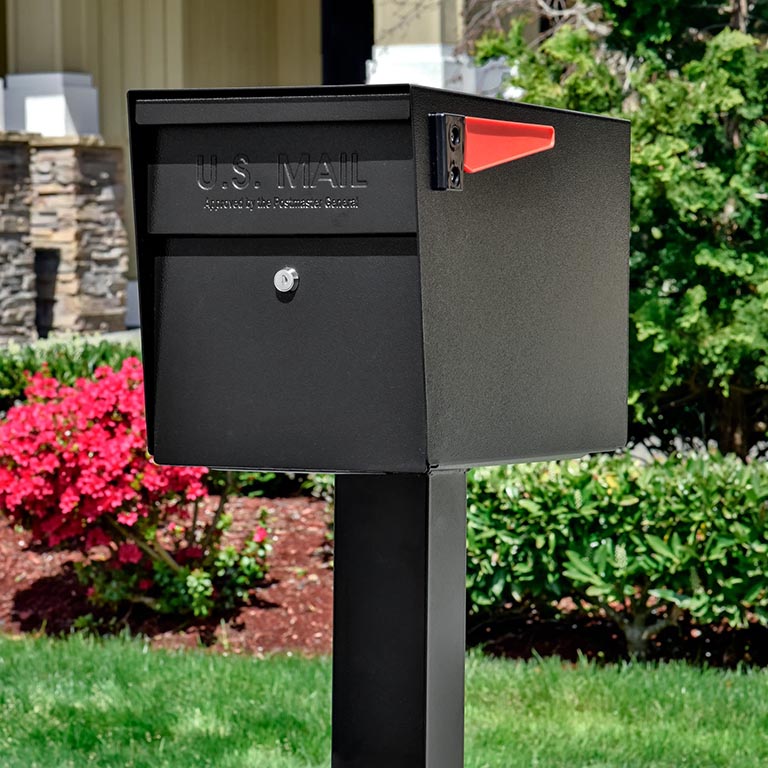
USPS locking mailbox requirements apply to both the model selection and the slot construction, since a unit that locks but can't accept a day's mail still fails compliance. Browse locking mailboxes that carry a valid PMG approval seal and meet the slot dimensions below.
-
Approved model: Must be USPS-approved; PMG seal required on the unit itself, not just the slot
-
Slot minimum: 1.75″ high × 10″ wide, large enough to accept an unfolded USPS Priority Mail flat-rate envelope without creasing
-
Capacity: Slot must accommodate daily mail volume plus the largest standard flat the household typically receives
-
Flap orientation: Protective flaps must orient inward so mail drops cleanly into the locked compartment without jamming
-
Carrier access: Carriers do not accept keys or open locked compartments under any circumstances
-
Retrofitting: Locks are not permitted on traditional or contemporary non-locking designs; buyers must select a purpose-built locking model
The no-keys rule is operational, not bureaucratic. USPS carriers handle hundreds of stops per route and can't track keys for individual addresses without exposing the route to security risk and slowing delivery. If a carrier arrives with mail that won't fit through the slot, the carrier holds the mail and leaves a notice; repeated overflow can trigger a delivery suspension until the unit is replaced.
The most common compliance mistakes are retrofitting a decorative non-locking mailbox with an aftermarket lock, choosing a slot too narrow for Priority Mail flats, and installing the protective flap with outward orientation. Each of these can fail postmaster inspection even if the unit otherwise meets curbside or wall mount placement specs.
Cluster Mailbox (CBU) Requirements
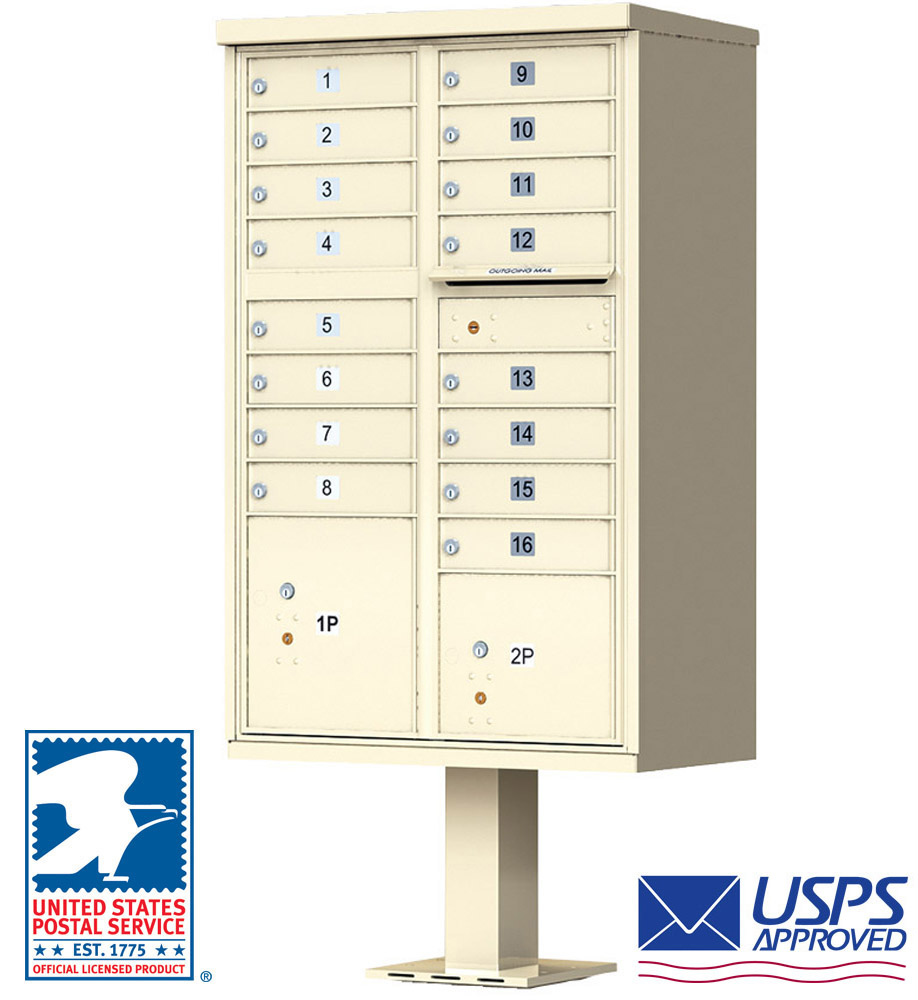
USPS cluster mailbox requirements place full responsibility for purchasing, installing, and maintaining the CBU on the builder or property owner. USPS supplies only the master arrow lock after the unit is in place. Browse cluster mailboxes or read our detailed USPS cluster mailbox regulations guide for additional compliance detail.
USPS prefers centralized delivery for all new addresses because it lets a single carrier serve dozens of households at one stop instead of driving door to door. The efficiency gain is significant: a 16-compartment CBU replaces 16 individual stops, which reduces route time, fuel cost, and exposure to weather and traffic. For new construction, centralized delivery is no longer a preference in most cases; it's the default delivery mode unless the postmaster approves an alternative.
USPS commercial mailbox requirements for CBU installations specify:
-
Delivery preference: Centralized delivery is the default for all new addresses
-
Ownership: Builder or property owner purchases, installs, and maintains the unit
-
Arrow lock: USPS installs the master arrow lock after installation; that step is not the owner's responsibility
-
Tenant keys: 3 keys per compartment ship with the unit
-
Foundation: Concrete pad required, sized to the manufacturer's footprint specs
-
Location approval: Local postmaster must approve placement before work begins
-
ADA compliance: ADA-compliant reach height and clear floor space required at every installation
If the builder installs without postmaster approval or chooses a non-compliant location, USPS can refuse to set the arrow lock and refuse to begin delivery to the development. That delay falls on the builder to resolve, often in the middle of move-ins. Confirming placement and unit configuration before pouring the concrete pad is the single most important step in the process.
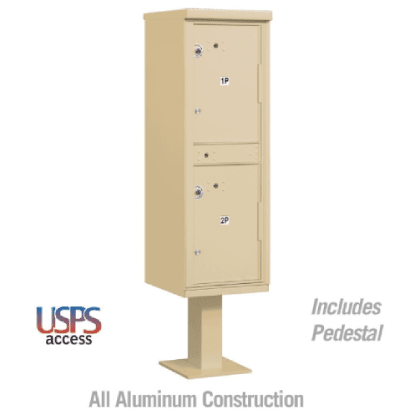
For installations in higher-risk areas, consider high-security cluster mailboxes with reinforced doors and vandal-proof anti-pry features. Outdoor CBUs should also include a canopy or weather shelter to protect tenants and mail during loading, and to reduce wear on the unit over time.
Parcel Locker Ratio Requirements
The 2020 USPS regulation change, per Postal Operations Manual Section 632.622, requires one parcel locker for every five mailbox compartments. The change reflects the post-pandemic shift in package volume: the previous 1:10 ratio was set when most deliveries were letter mail, and routine package overflow now triggers carry-out deliveries that the locker count was supposed to prevent.
The ratio directly determines which CBU model to select. A 16-compartment unit requires at least four parcel lockers. A 20-compartment unit requires four. A 13-compartment unit requires three. Builders ordering for a development should match the unit configuration to the projected number of households, not the lowest-cost model that fits the spot, since under-spec parcel lockers are a common reason for postmaster rejection at final inspection.
For a complete walkthrough of the CBU installation process, see our cluster mailbox installation guide.
4C Horizontal Mailbox Requirements
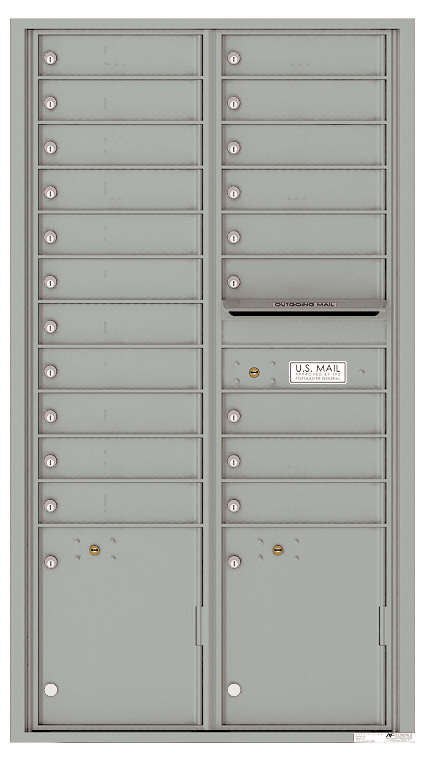
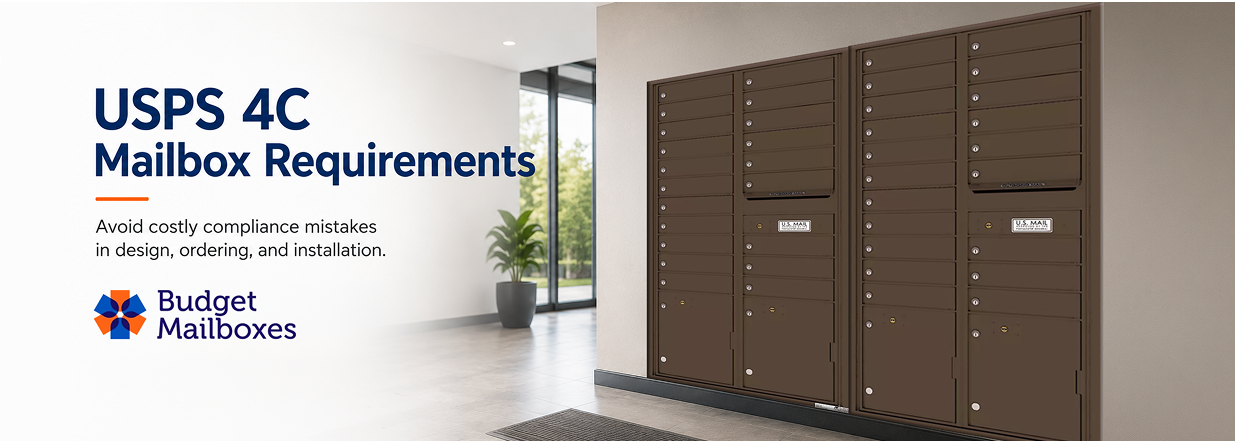
USPS 4C mailbox requirements apply to all new multi-unit residential and commercial construction since October 5, 2006. Browse 4C horizontal mailboxes built to USPS STD-4C compliance standards.
Apartment buildings, condominiums, dormitories, and mixed-use developments all fall under USPS apartment mailbox requirements, and the same STD-4C rule applies to office buildings, retail centers, and other commercial properties under USPS commercial mailbox requirements. The standard ensures consistent carrier access, mail security, and tenant accessibility across every centralized indoor delivery setup.
-
Mandate: Required for all new construction and renovation since October 5, 2006
-
Standard: Must comply with USPS STD-4C
-
Installation types: Recessed, surface mount, or depot cabinet
-
Indoor vs. outdoor: Both permitted; outdoor kiosk installations require a USPS-compliant canopy
-
4B+ units: Permitted only in existing buildings where a full 4C upgrade isn't feasible; replacement use only
A renovation triggers a 4C upgrade when the project replaces, relocates, or substantially modifies the existing mail infrastructure. Repainting a lobby doesn't require an upgrade, but tearing out an old 4B+ wall section to reframe or relocate the mail center does. The choice between recessed, surface mount, and depot cabinet usually comes down to wall depth and construction phase. Recessed installations need a 15-inch minimum rough opening depth and are easiest to specify before drywall goes up. Surface mount works on finished walls without cutting into the structure. Depot cabinets are freestanding and suit lobbies where wall mounting isn't practical.
The 4B+ standard is restricted to replacement use because its dimensions and security features fall short of STD-4C, particularly around parcel handling and tenant lock options. Whether the project falls under USPS commercial mailbox requirements for an office build-out or USPS apartment mailbox requirements for a residential renovation, the postmaster's placement sign-off is the gate that determines compliance.
For detailed 4C installation instructions including recessed, surface mount, and depot cabinet options, see our Florence 4C mailbox installation manual.
USPS Mailbox Requirements for New Construction
Mailbox requirements for new construction begin before a single plan is finalized. Builders who wait until framing is complete to address mail delivery routinely face postmaster rejections, delayed move-ins, and rework costs that could have been avoided with a single coordination call early in design.
The first step is to contact the local USPS office during the design phase, before site plans go out for permit. The point of contact is the USPS Growth Manager assigned to the project area, who handles new-construction coordination across delivery mode determination, CBU placement, and route planning. A quick call or written request at this stage establishes the project on the post office's radar and starts the delivery mode conversation.
USPS will determine the delivery mode, not the builder. Centralized delivery through CBUs or 4C horizontal mailboxes is the default for new addresses, and a curbside or door-to-door arrangement requires a specific case for approval. Bring the site plan, unit count, projected occupancy date, and intended mailbox location to the conversation. The Growth Manager uses these to confirm the delivery mode, approve the placement, and flag any access or accessibility issues before construction begins.
USPS mailbox installation requirements for new builds specify:
-
Notify USPS during design, before plans are finalized
-
Builder purchases and installs all USPS-approved equipment, including the CBU or 4C unit
-
Street signs, house numbers, and satisfactory walkways must be in place before delivery begins
-
Work through the local USPS Growth Manager for all coordination
-
Any renovation that triggers a mailbox replacement also triggers an upgrade to current USPS standards; 4B+ units are not acceptable in renovation scenarios
Timeline matters. Postmaster approvals typically take two to four weeks once the site plan is submitted, and the master arrow lock can only be installed after the unit is in place and the development is ready for occupancy. Building that timeline into the construction schedule prevents the most common new-construction delivery delay: a finished development with no active mail service. Browse mailboxes for new construction to see USPS-approved options for every project size.
ADA Accessibility Requirements for Mailboxes
USPS ADA mailbox requirements apply to all multi-family and commercial installations alongside USPS placement standards. Both sets of requirements apply simultaneously, and satisfying one without the other leaves the installation non-compliant.
-
Reach height: Forward and side reach must fall within the 15–48″ accessible range
-
Clear floor space: At least 30 × 48″ in front of each mailbox array
-
Approach pathways: Must be firm, stable, and slip-resistant from the parking area to the unit
The two rule sets can conflict on tall units. A 4C horizontal cabinet with compartments stacked above 48 inches meets USPS STD-4C dimensional requirements, but the top compartments fall outside the ADA accessible reach range. Builders typically resolve this by assigning the highest compartments to standard tenants and reserving the middle and lower rows (within the 15-48 inch zone) for tenants with mobility needs. The unit itself doesn't change; the assignment plan does.
Confirm both ADA and USPS requirements with the local postmaster and an accessibility coordinator before finalizing placement.
When to Replace a Non-Compliant Mailbox
USPS mailbox regulations require an upgrade to current standards any time a renovation triggers a mailbox replacement. Buyers can't carry forward a non-compliant unit into a new project, and a postmaster can refuse to begin or continue delivery to an installation that fails any of the current USPS mailbox requirements.
Common violations of USPS mailbox requirements include:
-
Wrong height: Unit sits outside the 41–45″ range, most often on posts that have settled, leaned, or been replaced without measuring
-
Non-breakaway post: Concrete, heavy steel, or improvised anchors that fail Federal Highway Administration breakaway standards
-
Weather damage: Door, hinge, or flag mechanism compromised to the point that mail isn't fully protected from rain, snow, or wind
-
Missing markings: Address digits absent, faded below visibility, or under the 1″ minimum height
-
Aftermarket lock retrofits: Locking hardware added to a non-locking PMG-approved unit, which voids compliance
To verify PMG approval on an existing unit, check the manufacturer name and model number against the USPS-approved models database. If the unit is unmarked, undocumented, or older than the current generation of approved models, treat it as non-compliant and plan a replacement.
The four-step correction process:
-
Assess the current unit. Measure height, inspect the post for breakaway compliance, check the address markings, and confirm the PMG seal is present and legible.
-
Select a compliant replacement. Match the unit type to the property and delivery mode; for curbside, that's a PMG-approved unit on a breakaway post.
-
Install to current dimensional standards. Use the height and setback specs covered earlier in this guide, and follow the post burial depth and material rules.
-
Confirm placement with the local postmaster. A quick walk-through or photo confirmation prevents delivery delays after install.
Browse mailboxes for replacement use or shop the full residential mailbox collection.
Shop USPS-Approved Mailboxes at Budget Mailboxes
Budget Mailboxes carries USPS-approved mailbox options for every installation type in this guide. As an authorized dealer for Florence and Salsbury, we've supplied compliant residential, commercial, and multi-family mailboxes to homeowners, builders, property managers, and HOAs across the country for years, earning a reputation our customers point to in their reviews. Every order ships with bulk pricing and free shipping on qualifying purchases, and our team can help match the right unit to your project, postmaster requirements, and timeline. Call 866-707-0008 for project-specific guidance.
Shop by type: USPS-approved mailboxes | cluster mailboxes | 4C horizontal mailboxes | locking mailboxes | wall mount mailboxes
Curbside mailboxes must sit 41–45 inches above the road surface, 6–8 inches back from the curb, on the right-hand side in the carrier's direction of travel. The unit must carry a PMG approval seal and display address numbers at least 1 inch tall. The most significant recent change took effect in 2020: USPS now requires one parcel locker for every five mailbox compartments in all new CBU installations, per Postal Operations Manual Section 632.622. No. USPS specifies height, setback, road-side placement, and post standards for curbside units. Wall mount and cluster installations require postmaster approval for the specific location before work begins. Curbside and locking mailboxes require a PMG approval seal. Wall mount mailboxes don't require the seal but must meet USPS capacity and placement standards. CBU and 4C installations must comply with USPS STD-4C. Yes. Once USPS delivers mail into a mailbox, it's considered a federal mail receptacle. Tampering with or removing mail is a federal offense under 18 U.S.C. § 1705.Frequently Asked Questions About USPS Mailbox Requirements